Click here to access the web version or the PDF version (~4 MB).

As we are slowly progressing towards the end-of-the-year season, it is a pleasure to share with you the latest news and achievements from the ICDP community. This edition of the newsletter is rich with updates: drilling projects are advancing, workshops have inspired new collaborations, and preparations are underway for upcoming international meetings. The coverage of news here highlights the vibrant activity within ICDP and our continued commitment to advance continental scientific drilling and Earth science.
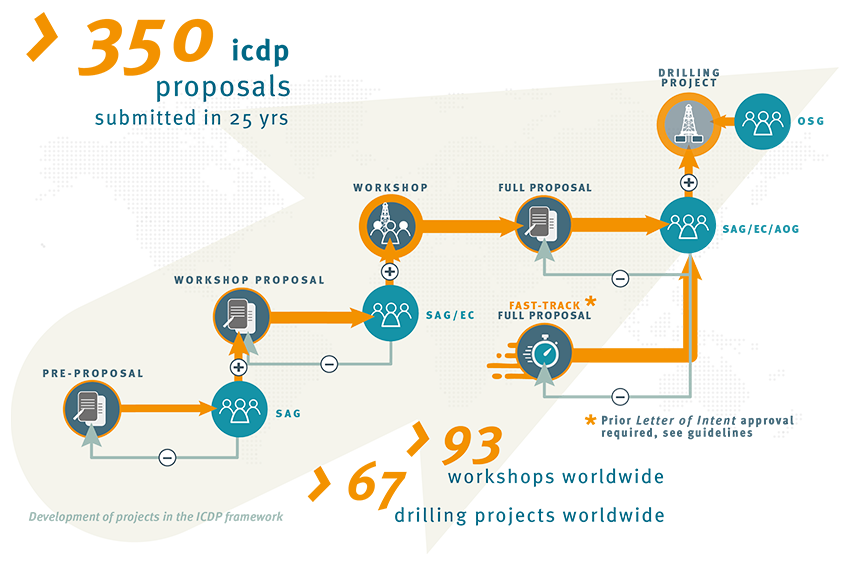
As a key highlight, ICDP has now realized a new funding line and welcomes submissions in the 'Fast-Track Proposal' category. This has been newly introduced to support projects already co-funded externally and with a timeline requiring fast action. We have also updated our Preliminary Proposal guidelines to streamline the compliance process, and look forward to receiving your innovative project ideas. Please see below and the ICDP proposal writing guidelines for details.
As to operative projects, drilling the Bushveld Complex in South Africa was completed in August at 1,877 m depth, the GOE-DEEP project in Gabon successfully completed Phase 1, the WEIHE drilling project reached 900 meters, and the SWAIS2C project in Antarctica is about to start the third drilling season (again during southern summer). Following successful ICDP workshops in Potsdam (KIND), Sicily (FlankEd), Finland (Deep-EGS), and South Africa (PROTEA), we look forward to see further project developments for all of them!
Meanwhile, preparations are ramping up for next year's Deep Chew Bahir Drilling Project (DeepCHB): Getting to the bottom of the Quaternary workshop in Addis Ababa, Ethiopia and Horoman Mantle Drilling and Carbon Injection (Horoman DC) workshop in Hokkaido, Japan. Don't miss the respective call!
Let us carry our spirit of inquiry forward into 2026 – and keep the drill bits rotating!
Marco Bohnhoff, ICDP Executive Director

New Fast-Track Proposal and Updated Preliminary Proposal Process
- 1. Fast-Track Full Proposals: Accelerating High-Impact Science
ICDP supports the integration of scientific research into ongoing drilling projects that offer exceptional opportunities. To enable rapid response to such cases, we now offer a fast-track process that allows applicants to bypass the pre-proposal and workshop stages. Please note that Fast-Track Proposals are an exception and may only be submitted after the Principal Investigators have sent a letter of intent to the ICDP Program Office and received an invitation to submit a full proposal.
- 2. Updated Preliminary Proposal Submission Process: Enhancing Scientific Quality
To keep high scientific standards amid growing proposal submissions, ICDP has refined the preliminary proposal process. Key updates include the requirement for:
- A cover sheet that includes first-order hypotheses or major scientific objectives addressable by the proposed drilling.
- A comprehensive response to any prior ICDP feedback.
- A limit of one re-submission.
Early submission is strongly encouraged. Submitting at least two months before the 15 January deadline allows for pre-screening to identify and resolve potential issues beforehand. Please see the guidelines for further details.

- 1. Join us at AGU25!
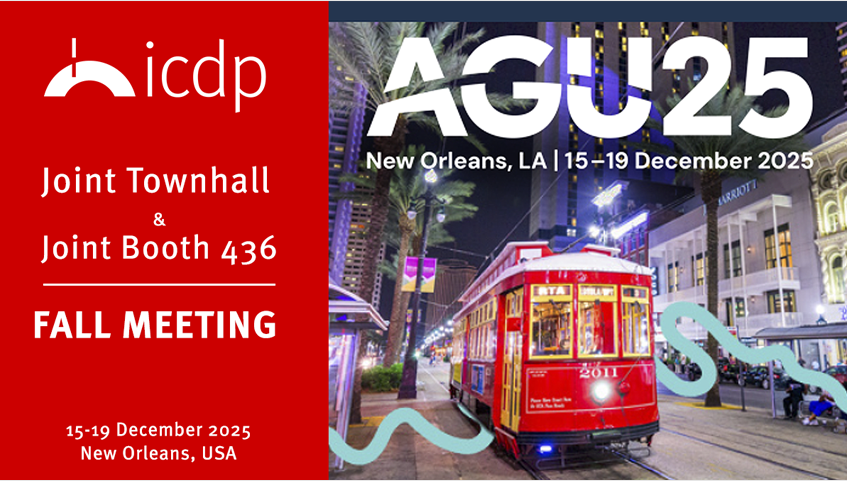
The American Geophysical Union (AGU) Annual Meeting will take place 15-19 December 2025 in New Orleans, USA, under the theme "Where Science Connects Us". This global event brings together Earth and Space scientists to share discoveries, exchange ideas, and promote collaboration.
- Join the ICDP/CSD Facility Town Hall to get the latest project updates from ICDP and the Continental Scientific Drilling (CSD) Facility. Meet us on Monday, 15 December 2025 (18:30 – 21:00) at the Cypress and Magnolia Room, SpringHill Suites New Orleans Warehouse District, 301 Saint Joseph St., New Orleans.
- 2. Looking Ahead: EGU26
ICDP is preparing for the European Geosciences Union (EGU) General Assembly 2026, to be held in Vienna 3-8 May. Join us at the joint ICDP–IODP³–ECORD Town Hall on Monday, 4 May, and submit your abstract to our signature session: ITS5.1/CL0.6 — Achievements and Perspectives in Scientific Ocean and Continental Drilling. Co-conveners: OSG member Cindy Kunkel and ICDP Early Career Researcher Kazuki Matsuyama.
Don't miss the related session: SSP3.8 — Limnogeology: Reading the Geological Record of Lakes. Co-conveners: ICDP Early Career Researchers Olga Schmitz and Lisa Feist.
The deadline for abstract submissions is Thursday, 15 January 2026, at 13:00 CET. Please follow the official instructions to submit your abstract.
We look forward to seeing you in Vienna for enthusiastic scientific discussions and networking!
- 3. Workshop Call: Deep Chew Bahir Drilling Project: Getting to the bottom of the Quaternary
The Chew Bahir Basin in southern Ethiopia is a crucial archive for
understanding climate, tectonics, ecosystems, and human history
during the Pleistocene. The Deep Chew Bahir Drilling Project (DeepCHB) aims to discuss drilling to 1,200 m, building on earlier
successes to explore new interdisciplinary research themes.
The workshop takes place in Addis Ababa, Ethiopia, from 30 June to
3 July 2026. Applications are open until
31 January 2026. Check the call
here.
- 4. Workshop Call: Horoman Mantle Drilling and Carbon Injection (Horoman DC)
Applications are open for the Horoman DC workshop, taking place 25–28 August 2026 in Hokkaido, Japan. This international ICDP workshop will develop a drilling proposal targeting the Horoman peridotite massif, aiming to investigate mantle carbonation processes through CO₂ injection experiments. The project addresses global carbon sink dynamics and advances subsurface CO₂ sequestration research. The deadline for applications is 8 May 2026. Download the call here.

- 1. Weihe Basin Deep Drilling Project (WEIHE)
Drilling began in Weinan, China, on 28 July 2025, withstanding both 40°C summer heat and heavy rains. Progress remains steady, with the WEIHE team retrieving 13–15 meters per day using wireline coring technology. The 30-meter drill rig has become a hub of outreach, hosting geoscientists, students, and summer school participants. Drilling continues toward the 3,000-meter target depth – so far, WEIHE reached 900 meters depth!
- 2. Gabon and Oxygenation of Earth - Drilling Early Earth Project (GOE-DEEP)
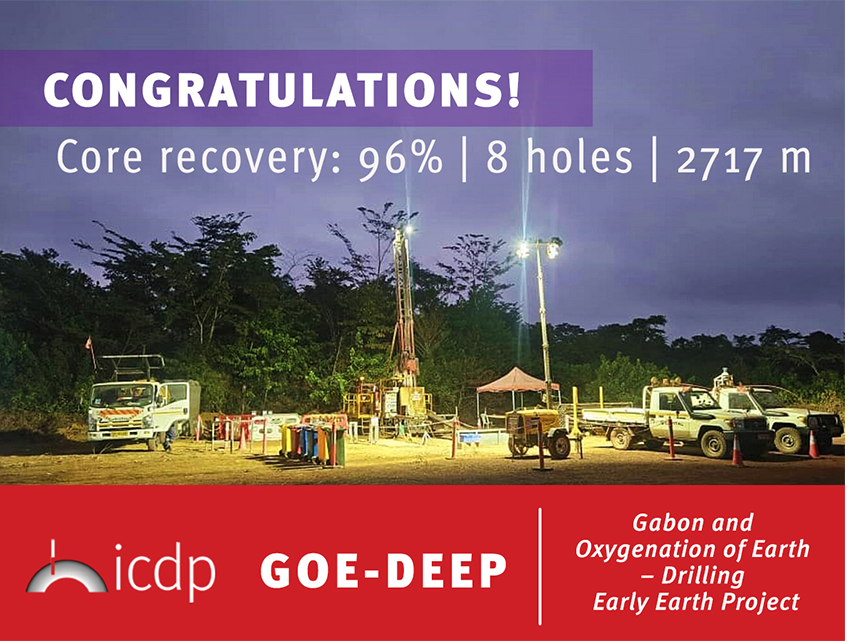
The GOE-DEEP Project in Gabon successfully completed drilling on 31 August 2025, finishing eight boreholes at eight sites in just three months. The team recovered 2,618 meters of core with a recovery rate above 99%, including a deepest hole of 512 meters. The cores are now en route to the Geological Survey of Norway (NGU), where analysis will begin in early 2026 using advanced techniques such as the ICDP core scanner to study this critical chapter of Earth's history.
- 3. Sensitivity of the West Antarctic Ice Sheet to 2 Degrees Celsius (SWAIS2C)
SWAIS2C's third season is about to get underway, at their Antarctic deep-field drilling camp at Crary Ice Rise on the Ross Ice Shelf. This remote site is more than 700 km from New Zealand's Scott Base. Antarctica New Zealand's traverse team are currently making their way across 1,100 km of the Ross Ice Shelf in a convoy of polar vehicles towing the drill rig and supplies to sustain the international team of 29 scientists, drillers, engineers and camp staff for the approximately 8-week field season. The team aims to retrieve up to 200 m of sediment, but must first melt a hole through 500 m of ice to access the bedrock below!
-
4. Establishing a Platform for Global Cooperation in
Scientific Drilling
First Scientific Drilling Forum – CNR-IAS, Capo Granitola, Sicily, Italy (13–16 October 2025)
Over 50 representatives from international scientific drilling programs — including the ICDP, China's Deep Ocean Drilling Program (DODP), the International Ocean Drilling Programme (IODP³), and the U.S. Ocean Drilling Program, met with funding agencies and stakeholders to discuss global cooperation. Participants identified shared priorities, explored joint initiatives, and discussed coordination on core sample management across programs. The forum's findings and consensus will be released soon.
- 5. Drilling Down into Knowledge: ICDP 2025 Training Course Recap
This year's training course (14–20 September, Weinan, China) combined theory with hands-on experience in drilling engineering, coring, downhole logging, and sample management. Participants visited the WEIHE Project site to observe live drilling operations and took part in a workshop on science communication through photography. A highlight was the presentation by Olga Schmitz and Romina Achaga from the ICDP ECR Network Steering Committee, who encouraged participants to join the growing network. The course once again proved to be a cornerstone for training the next generation of continental scientific drillers.
Stay tuned to the ICDP channels for more updates, calls, and project milestones.
